NEC Conduit Fill Rules: What Every Electrician Must Know
NEC Chapter 9 limits conduit fill to 40% for 3+ conductors. Learn the exact rules, why they exist, and how to apply them on every job.
Quick Answer
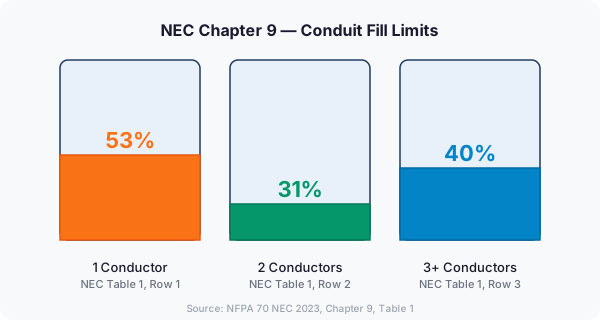
The NEC limits conduit fill to 53% for 1 conductor, 31% for 2 conductors, and 40% for 3 or more conductors (NEC Chapter 9, Table 1). These limits apply to all metallic and non-metallic conduit types covered by NFPA 70.
Conduit fill is one of those NEC requirements that looks simple on paper but trips up experienced electricians on complex jobs. Get it wrong and you're looking at a failed inspection, a wire re-pull, or worse - an overheating failure inside the wall.
Here's the complete breakdown of the rules, why they exist, and how to apply them correctly every time.
Why NEC Limits Conduit Fill
The NEC sets fill limits for two reasons: heat and pulling tension.
Multiple current-carrying conductors sharing a conduit generate more heat than wires run in open air. The more tightly packed the conduit, the less efficiently that heat dissipates. NEC 310.15(B)(3)(a) requires ampacity derating when there are more than three current-carrying conductors in a conduit - and the fill limits in Chapter 9 work hand-in-hand with that derating requirement.
Pulling tension matters too. A conduit stuffed beyond 40% becomes physically hard to pull wire through - especially around bends. The fill limits reduce the friction load to a point where a two-person team can pull a run without damaging insulation.
The Three Fill Limits (NEC Chapter 9, Table 1)
1 conductor: 53% maximum
A single conductor has low pull friction and generates heat on only one conductor surface. The 53% limit reflects the reduced thermal and mechanical concern.
2 conductors: 31% maximum
Two conductors running parallel create a flat contact point where heat builds up between them. The lower 31% limit creates enough air gap to manage that heat concentration. Two conductors also jam together during pulls in a way a single wire doesn't - the lower fill limit gives just enough space to slide.
3 or more conductors: 40% maximum
Three or more conductors round out their cross-sections relative to each other. The cumulative heating effect is the dominant concern. Forty percent leaves enough internal space for air circulation and future pull access. This is the limit most electricians deal with on every job - branch circuits, feeder runs, and sub-panel feeds all typically land here.
What Counts Toward Fill?
All conductors in the conduit count - current-carrying and non-current-carrying alike. That includes:
What does not count: the physical conduit fitting itself, wire pulling lubricant, or any conduit accessories. Just the conductors.
Which Conduit Types These Rules Apply To
NEC Chapter 9 fill rules apply to:
Each conduit type has its own Table 4 dimensions. Using the wrong table is one of the most common fill calculation errors.
How to Look Up Conduit Fill by Hand
Example: 4 × 12 AWG THHN in ¾-inch EMT.
You can verify this result instantly using our conduit fill calculator.
Common Fill Violations and How to Avoid Them
Forgetting the ground wire. A 20A circuit has three 12 AWG current-carrying conductors plus one 12 AWG EGC. That's four conductors, not three. Running the fill calculation with three wires when there are four can push a ½-inch conduit from borderline-pass to fail.
Using the wrong conduit type in the calculation. A ½-inch Schedule 80 PVC has 0.217 in² interior area. A ½-inch EMT has 0.304 in². Selecting the wrong type gives you a 40% error before you've done any math.
Treating trade size as actual diameter. ¾-inch EMT has a 0.922-inch interior diameter - not 0.75 inches. The trade size is a nominal designation. Always look up the actual area in Table 4; never calculate it from the trade size number.
Mixing wire sizes without summing individually. If you run 2 × 10 AWG and 4 × 12 AWG in the same conduit, you can't use a single wire size for the calculation. Sum each conductor's individual Table 5 area value.
The Derating Connection
When you have more than three current-carrying conductors in a conduit, NEC 310.15(B)(3)(a) requires you to derate conductor ampacity. At 4-6 conductors: multiply allowable ampacity by 0.80. At 7-9 conductors: multiply by 0.70. At 10-20 conductors: multiply by 0.50.
This derating requirement means fill compliance alone isn't enough on dense conduit runs. A ½-inch EMT might technically pass the 40% fill test with eight 14 AWG THHN wires, but the ampacity derating makes those wires undersized for the load. Conduit fill and ampacity derating must both be checked.
For more on that topic, see our guide on wire derating and how conduit fill affects ampacity.
Practical Sizing Tips
When you calculate near or above the fill limit, your options are:
Use the NEC conduit fill calculator to run these scenarios before you cut conduit. Catching a fill violation at the planning stage costs nothing. Catching it during rough-in inspection costs you a re-pull.
Key NEC References
NFPA 70 is updated on a three-year cycle. Always verify you're referencing the edition adopted by your jurisdiction - some states and municipalities lag one cycle behind.
Conduit Fill Calculator Team
Electrical professionals building free, NEC-accurate conduit fill tools for working electricians, contractors, and inspectors.