Wire Derating and Ampacity: How Conduit Fill Affects Conductor Ratings
Passing the conduit fill test isn't enough. High conductor counts require ampacity derating per NEC 310.15. Here's exactly how to apply it.
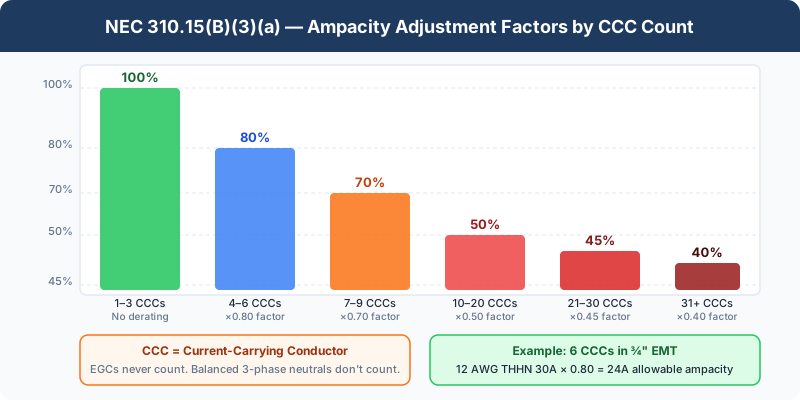
The Numbers
When a conduit contains more than 3 current-carrying conductors, NEC 310.15(B)(3)(a) requires you to derate conductor ampacity: 80% for 4-6 conductors, 70% for 7-9, 50% for 10-20, 45% for 21-30. A 12 AWG THHN rated at 30A at 90°C becomes effectively 24A-capable with 4-6 CCC in the same conduit - still fine for a 20A circuit, but the margin matters on tightly loaded systems.
Conduit fill and ampacity derating are two separate NEC requirements. Passing the fill percentage check doesn't mean you're done. If you have more than three current-carrying conductors (CCCs) in a conduit, you have a derating problem to solve too.
This matters on panel feeders, multi-circuit conduit runs, and any installation where you're packing multiple circuits into a single conduit for cost savings.
What Causes the Derating Requirement
Multiple current-carrying conductors in an enclosed space generate heat that can't escape as efficiently as open-air wiring. Each conductor's heat adds to the thermal environment around all the others. The practical result: conductors in packed conduit can't carry as much current as they can in a less-loaded environment.
NEC 310.15(B)(3)(a) accounts for this with adjustment factors based on the number of current-carrying conductors.
The Derating Factors (NEC 310.15(B)(3)(a))
| Number of CCCs | Adjustment Factor |
|---|---|
| 1-3 | 1.00 (no derating) |
| 4-6 | 0.80 |
| 7-9 | 0.70 |
| 10-20 | 0.50 |
| 21-30 | 0.45 |
| 31-40 | 0.40 |
| 41+ | 0.35 |
CCC means current-carrying conductor. Neutral conductors that carry only the unbalanced load of a balanced 3-phase system don't count. Standard single-phase neutral conductors carrying return current DO count. Equipment grounding conductors (EGCs) never count toward CCC totals.
Working Through a Derating Example
A panel feeder conduit contains 8 conductors total: 6 CCCs (three 10 AWG phase conductors and three 10 AWG neutrals for three separate 2-wire circuits) plus 2 EGCs (10 AWG, not counted in CCC total).
CCC count: 6 → derating factor: 0.80
From NEC 310.15(B)(16), 10 AWG THHN has an allowable ampacity of 40A at 90°C in conduit. After derating: 40 × 0.80 = 32A.
Each of those circuits is protected by a 20A breaker, so the derated 32A easily covers the load. But if any of those circuits had a 30A breaker, you'd be right at the limit - and that's before applying ambient temperature correction.
Ambient Temperature Correction
NEC Table 310.15(B)(2)(a) provides temperature correction factors when the ambient temperature exceeds 30°C (86°F). In a hot attic at 45°C (113°F), a 90°C-rated conductor needs a correction factor of 0.87.
If you have both a temperature correction AND a CCC derating, multiply them together.
Example: 6 CCCs (factor 0.80) in 45°C ambient (factor 0.87):
Combined factor: 0.80 × 0.87 = 0.696
A 10 AWG THHN rated at 40A × 0.696 = 27.8A allowable in that environment. A 20A circuit still passes, but a 30A circuit would not.
When Derating Changes Conduit Planning
Derating doesn't mean you can't pack a conduit - it means your conductor sizing must account for it.
Scenario: You need to run four 20A/120V circuits in one conduit to save labor. Each circuit needs a 12 AWG THHN hot and neutral (2 CCCs per circuit × 4 circuits = 8 CCCs). You also need a shared EGC.
CCC count: 8 → derating factor: 0.70
12 AWG THHN base ampacity at 90°C: 30A
Derated: 30 × 0.70 = 21A
NEC 110.14(C) limits you to the 75°C column for most terminations, so the effective base is 20A (the 75°C rating for 12 AWG). Apply 0.70: 20 × 0.70 = 14A.
That's under the 20A circuit requirement. You'd need to upgrade to 10 AWG THHN conductors (base ampacity 35A at 75°C × 0.70 = 24.5A - passes for 20A protection).
This is why derating forces conductor upsizing on multi-circuit conduit runs. Four 20A circuits in a conduit sometimes requires 10 AWG wire even though 20A circuits typically use 12 AWG.
The Interaction with Conduit Fill
Running larger conductors because of derating also increases your conduit fill. If you upgrade from 12 AWG to 10 AWG for eight conductors, your fill calculation changes:
8 × 10 AWG THHN (0.0211 in²) = 0.1688 in²
In ¾-inch EMT (0.533 in²): 0.1688 ÷ 0.533 = 31.7% fill - still under the 40% limit.
But now verify on the fill calculator: select EMT, ¾-inch, THHN, 10 AWG, 9 conductors (8 CCCs + 1 EGC). Use our conduit fill calculator for the instant answer.
What Counts as a CCC?
Always counts:
Never counts:
Counts in some cases:
NEC References
For fill calculation verification alongside your derating analysis, use the NEC conduit fill calculator. For an overview of the fill rules themselves, see NEC conduit fill rules explained. If you're sizing conduit from scratch, see how to size conduit for any wiring job.
Conduit Fill Calculator Team
Electrical professionals building free, NEC-accurate conduit fill tools for working electricians, contractors, and inspectors.