How Conduit Bends Affect Fill Calculations and Pull Tension
Conduit bends don't change NEC fill percentages, but they dramatically affect wire pull difficulty. Learn the relationship between bends, fill, and safe pulling practices.
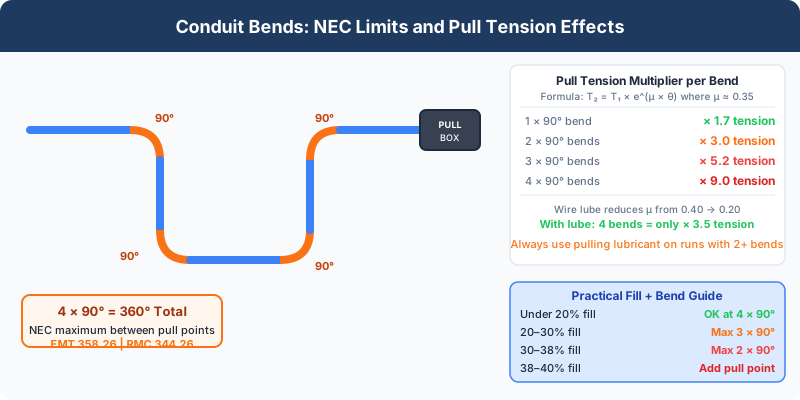
Bottom Line
Conduit bends don't change the NEC fill percentage - the calculation uses the straight conduit interior area regardless of bends. But bends significantly increase pull tension. NEC 358.26 limits EMT conduit runs between pull points to a maximum of four 90-degree bends (360 degrees total). High fill combined with multiple bends creates pull tension that can damage wire insulation.
NEC conduit fill rules calculate the percentage of a conduit's cross-sectional area occupied by conductors. That calculation is the same whether the conduit is straight or has three 90-degree bends. But any experienced electrician knows that a conduit crammed to 38% fill with four 90s is a nightmare to pull compared to a straight run at the same fill percentage.
The interaction between bends and fill comes down to pull tension. Below are the rules, the math, and the layout decisions that keep a run code-legal and physically pullable.
NEC Bend Rules by Conduit Type
The NEC limits the amount of bending between pull points for each raceway type. These limits are designed to keep pull tension manageable.
EMT (NEC 358.26): Maximum 360 degrees total (four 90-degree bends) between pull points.
IMC (NEC 342.26): Same 360-degree maximum.
RMC (NEC 344.26): Same 360-degree maximum.
PVC (NEC 352.26): Same 360-degree maximum.
A "pull point" is a conduit body, pull box, junction box, outlet box, or other accessible fitting where you can access and pull wire. If your run has more than 360 degrees of bends, you must add a pull point.
How Bends Increase Pull Tension
When you pull wire through conduit, you're working against friction between the wire's insulation and the conduit interior wall. Straight conduit has relatively low friction. Bends convert pulling force into increased normal force against the conduit wall - which multiplies the friction load.
The standard formula for pull tension around a bend uses the coefficient of friction and the angle:
T₂ = T₁ × e^(μ × θ)
Where:
For a single 90-degree bend with μ = 0.35:
T₂ = T₁ × e^(0.35 × 1.57) = T₁ × 1.73
Your pulling force increases by 73% through a single 90-degree bend. Four 90-degree bends: tension multiplies by 1.73⁴ = 9.0x the initial tension.
This means a 50-pound pull force at the start becomes 450 pounds at the end of a four-90-degree-bend run - even before accounting for wire weight in long runs. This is why low-friction wire lubricant is essential on anything more than one or two bends.
Fill and Bend Interaction: The Practical Reality
Higher fill means more wire pressing against conduit walls. More wire against walls means more friction per bend. The combination of high fill and many bends is the primary cause of wire insulation damage during pulls.
Rule of thumb for field planning:
| Conduit Fill | Max Bends Before Adding a Pull Point |
|---|---|
| Under 20% | 4 × 90° (NEC maximum) |
| 20-30% | 3 × 90° (practical maximum) |
| 30-38% | 2 × 90° (keep pull effort manageable) |
| 38-40% | 1 × 90° or add pull point |
These aren't NEC requirements - they're field experience guidelines that experienced electricians follow to avoid damaged insulation and failed pulls. The NEC minimum (360 degrees between pull points) is a code floor, not a recommendation.
Wire Lubricant and Its Impact
Applying wire pulling lubricant (pull lube or wire gel) to conductors before pulling can reduce the friction coefficient from 0.4 to around 0.2 - cutting the tension multiplier per bend roughly in half. For a four-bend run:
Without lubricant (μ = 0.4): T₂ = T₁ × e^(0.4 × 6.28) = T₁ × 12.4x
With lubricant (μ = 0.2): T₂ = T₁ × e^(0.2 × 6.28) = T₁ × 3.5x
That's the difference between a nearly impossible pull and a manageable one. Never pull wire through multiple bends without lubricant. Use a product compatible with the wire insulation - most modern THHN/THWN-2 is compatible with standard wire-pulling gels.
Pull lube doesn't change NEC fill calculations. But it should always be part of your plan on any run with more than two bends.
Kinks at Bends and Their Effect on Fill
A kinked conduit at a bend has a reduced interior cross-section. While NEC fill calculations don't account for kinks (they assume nominal conduit dimensions), a significant kink creates a physical restriction. A kinked ¾-inch EMT might have an effective interior opening of 0.35 in² at the kink point versus the nominal 0.533 in².
If you have a kinked conduit installed and you're near the fill limit, inspect the kink carefully. If the inside radius is deformed enough to narrow the opening more than trivially, the section should be replaced. An inspector can reject a run with visible kinking even if the paper calculation shows compliance.
Pull Box Sizing at High-Fill Runs
When you add a pull box to break up a run with too many bends, NEC 314.28 governs pull box sizing. For straight pulls: minimum box dimension = 8 × the trade size of the largest conduit. For angle pulls: minimum = 6 × trade size.
A run of ¾-inch EMT making an angle pull through a pull box needs a pull box at least 4.5 inches in the dimension parallel to the pull direction (6 × 0.75 = 4.5 inches).
This is a separate calculation from fill - but both need to be right before inspection.
Planning Conduit Layouts to Minimize Bends
The most effective way to manage the bend-fill tension problem is to minimize bends in the layout:
For fill calculations on any segment of your conduit run, use the NEC conduit fill calculator. For general conduit sizing methodology, see how to size conduit for any wiring job. For the fill rules, see NEC conduit fill rules.
Conduit Fill Calculator Team
Electrical professionals building free, NEC-accurate conduit fill tools for working electricians, contractors, and inspectors.