How to Size Conduit for Any Wiring Job (Step-by-Step)
Conduit sizing comes down to NEC fill limits and the wires you need to run. Follow this step-by-step method for any conduit type and wire combination.
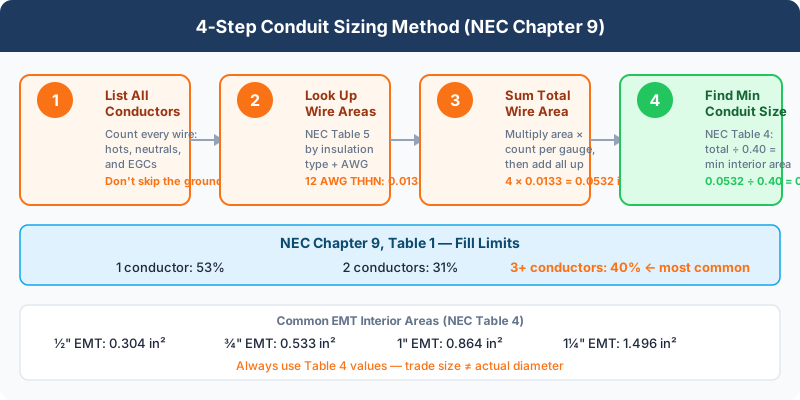
The Method in 30 Seconds
To size conduit: add up all conductor cross-sectional areas from NEC Table 5, then find the smallest conduit from NEC Table 4 whose 40% allowable area exceeds that total. For a 20A circuit with 4 × 12 AWG THHN conductors, total area = 4 × 0.0133 = 0.0532 in². The 40% allowable area of ½-inch EMT is 0.304 × 0.40 = 0.122 in² - well above 0.0532 in², so ½-inch EMT passes.
Conduit sizing has a reputation for being complicated. It's not, once you understand what you're actually calculating. The NEC gives you two tables - one for conduit interior areas and one for wire cross-sections - and the math is just addition and division.
This guide walks through the sizing process step by step, from a simple single-circuit run to a multi-circuit feeder.
The Sizing Process in 4 Steps
Step 1: List every conductor going into the conduit
Write down every wire: phase conductors, neutral conductors, and equipment grounding conductors. Count them all. NEC Article 300.17 requires that all conductors in a conduit be counted for fill purposes - there are no exceptions for "just a ground wire."
Example: a 20A/240V circuit with two hots and one EGC. Three conductors, all 12 AWG THHN.
Step 2: Look up each conductor's cross-sectional area
Open NEC Chapter 9, Table 5 and find the conductor area for each wire type and AWG. Or use the conduit fill calculator which has these values built in.
Common 12 AWG THHN/THWN-2 area: 0.0133 in²
Common 10 AWG THHN/THWN-2 area: 0.0211 in²
Common 8 AWG THHN/THWN-2 area: 0.0366 in²
Common 6 AWG THHN/THWN-2 area: 0.0507 in²
Step 3: Add up the total conductor area
Multiply each wire's area by the number of that wire type, then sum everything.
Three 12 AWG THHN: 3 × 0.0133 = 0.0399 in²
For mixed wire sizes, do this for each size and add the results.
Step 4: Find the smallest conduit that passes
For 3 or more conductors, the NEC allows 40% fill (NEC Chapter 9, Table 1). Divide your total conductor area by 0.40 to find the minimum conduit interior area needed.
Required interior area = 0.0399 ÷ 0.40 = 0.0998 in²
Now find the smallest conduit in NEC Chapter 9, Table 4 with an interior area ≥ 0.0998 in².
For EMT:
So ½-inch EMT handles three 12 AWG THHN conductors with room to spare.
Worked Example: 200A Service Feed
A residential service uses four 2/0 AWG THHN conductors (2 hots + 1 neutral + 1 EGC) in RMC.
From NEC Table 5, 2/0 AWG THHN area: 0.2223 in²
Total: 4 × 0.2223 = 0.8892 in²
Required interior area (40% limit): 0.8892 ÷ 0.40 = 2.223 in²
From NEC Table 4 for RMC:
The minimum RMC trade size for this service is 2-inch. Verify quickly with our fill calculator by selecting RMC, 2-inch, THHN, 2/0 AWG, 4 conductors.
Sizing for Mixed Wire Gauges
Mixed-gauge fills are common in panel feeders and sub-panel runs. Follow the same process - just break it into groups by size.
Example: 6 × 12 AWG and 2 × 10 AWG THHN in EMT.
12 AWG group: 6 × 0.0133 = 0.0798 in²
10 AWG group: 2 × 0.0211 = 0.0422 in²
Total: 0.1220 in²
Required interior area: 0.1220 ÷ 0.40 = 0.305 in²
From Table 4 (EMT):
The minimum conduit is ¾-inch EMT. The ½-inch failed by just 0.001 in². That's a reminder to always calculate rather than estimate.
One-Conductor and Two-Conductor Runs
For a single conductor (e.g., a motor feeder in its own conduit), the NEC allows 53% fill.
Required interior area = conductor area ÷ 0.53
For two conductors (e.g., a 2-wire circuit without a ground), the limit is 31%.
Required interior area = total area ÷ 0.31
Two-conductor fill limits are more restrictive than three-conductor limits. A ½-inch EMT can hold two 8 AWG THHN conductors at 31% fill: total area = 2 × 0.0366 = 0.0732 in², required = 0.0732 ÷ 0.31 = 0.236 in² - ½-inch (0.304 in²) works. Add a third conductor and the limit becomes 40%: required = 0.0366 × 3 ÷ 0.40 = 0.275 in² - ½-inch still works, but the margin shrinks significantly.
Don't Forget Future Capacity
NEC doesn't require you to size conduit for future circuits. But planning is smart - going up one trade size from ½ to ¾-inch EMT adds minimal cost and may save a costly re-pull later if circuits are added.
A common rule of thumb: when the calculated minimum conduit size lands at ½-inch, evaluate whether ¾-inch makes sense for future capacity. The cost difference is usually under $50 for a typical branch circuit run.
Sizing Shortcuts That Get Electricians in Trouble
Using a "table from memory." Conduit area values vary by conduit type. The ¾-inch EMT area (0.533 in²) is not the same as ¾-inch RMC (0.533 in² - actually the same in this case, but not for all sizes). Always look up the specific conduit type.
Assuming a larger conduit always fixes a fill problem. Sometimes the real issue is conductor derating from too many current-carrying conductors, not fill. Upsizing the conduit doesn't help with NEC 310.15(B)(3)(a) derating - you'd need to add another conduit or reduce circuit count per conduit.
Using the nominal trade size as a diameter. ¾ doesn't mean 0.75 inches of interior diameter. Look up the actual Table 4 value.
For detailed fill calculations at any combination of conduit type, size, wire type, and count, use the conduit fill calculator - it applies Tables 4 and 5 automatically. For the NEC rules governing fill, see NEC conduit fill rules explained. For details on how conduit type affects your options, see EMT vs IMC vs RMC.
Conduit Fill Calculator Team
Electrical professionals building free, NEC-accurate conduit fill tools for working electricians, contractors, and inspectors.