Conduit Fill in Commercial Wiring: Feeders, Panels, and High-Density Runs
Commercial electrical work pushes conduit fill calculations harder than residential. Learn how to handle feeders, multi-circuit runs, and high-density panel feeds.
TL;DR
Commercial conduit fill follows the same NEC Chapter 9 rules as residential - 40% for 3+ conductors - but commercial jobs typically involve larger conductors, more circuits per conduit, and higher-stakes consequences for calculation errors. The key issues are feeder sizing, pull box placement, and conductor derating on multi-circuit runs.
Commercial electrical projects put NEC fill rules to the test in ways that residential work rarely does. A 400-circuit lighting panel feed, a high-density office buildout with 30 branch circuits in a few conduits, or a multi-tenant commercial kitchen with large appliance feeders all require careful fill calculations before any conduit goes in the ceiling.
Feeder Runs and Large Conductor Fills
Commercial main and distribution feeders use large conductors - 250 kcmil, 350 kcmil, and larger are common. At these sizes, each individual conductor takes significant conduit space.
Example: 400A commercial feeder
A 400A service requires a conductor sized at 500 kcmil THHN (minimum, before derating). A typical 3-phase 400A feed has:
Total wire area: 4 × 0.7854 + 0.1963 = 3.1416 + 0.1963 = 3.338 in²
Required conduit interior area (40% limit): 3.338 ÷ 0.40 = 8.345 in²
From NEC Table 4 for EMT: 3½-inch EMT has 9.731 in² - that's the minimum trade size. This single feeder needs a 3½-inch EMT.
Calculate this in seconds using our conduit fill calculator: select EMT, 3.5-inch, THHN, 500 kcmil, 4 conductors - then add the EGC calculation separately.
Multi-Circuit Branch Circuit Runs
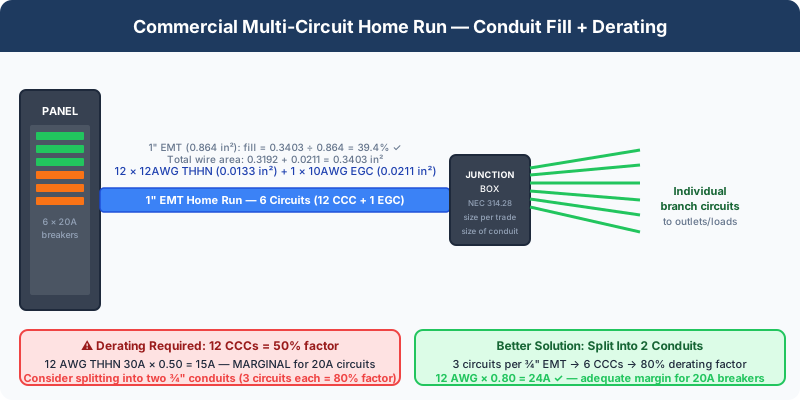
Commercial buildouts often run multiple branch circuits in a single home run conduit from the panel to a junction box, then branch out to individual outlets. This is more cost-effective than separate conduits per circuit but requires careful fill planning.
Example: 6-circuit office branch circuit home run
Six 20A/120V circuits in a single EMT conduit to a distribution junction box. Each circuit: 2 × 12 AWG THHN CCC (hot + neutral) + shared EGC.
Conductors: 12 hots + 12 neutrals + 1 × 10 AWG shared EGC
= 24 × 12 AWG THHN + 1 × 10 AWG THHN
Wire area: 24 × 0.0133 + 0.0211 = 0.3192 + 0.0211 = 0.3403 in²
Required interior area: 0.3403 ÷ 0.40 = 0.851 in²
From Table 4 (EMT): 1-inch EMT has 0.864 in² - just barely sufficient. Use 1-inch EMT.
But wait - 24 current-carrying conductors trigger significant ampacity derating (NEC 310.15(B)(3)(a)): 50% factor for 10-20 CCC. With 24 CCCs (hot and neutral), you need the derating table entries for 21-30 CCCs: 45% factor.
12 AWG THHN at 90°C: 30A × 0.45 = 13.5A allowable. With 20A circuit breakers and typical office loads at 50-80% of breaker rating, actual load is 10-16A - but the derated ampacity of 13.5A is uncomfortably close to the breaker rating.
This is a case where splitting into two conduits is the right answer: 3 circuits per conduit instead of 6. With 6 CCCs per conduit: 80% derating factor. 12 AWG × 0.80 = 24A - plenty of margin for 20A circuits. And each conduit is comfortably sized at ¾-inch EMT.
See the wire derating guide for the complete derating calculation.
Lighting Panel Home Runs
Commercial lighting panels often have large numbers of circuits sharing a conduit. A lighting home run might carry a dozen 20A circuits (hot + neutral each) plus EGCs, all running from the panel room to the first distribution box.
For high-density lighting runs, the conduit fill calculation and the CCC derating calculation should be done simultaneously. Fill determines conduit size; derating determines whether the conductor gauge is adequate. These calculations often interact - upgrading conductor size for derating increases fill, which may force a conduit upsize.
The systematic approach:
For feeders over 200A, this process often involves iteration - an initial guess at conductor size, fill calculation, derating check, conductor re-size if needed, re-check fill.
Pull Point Placement in Commercial Spaces
Commercial buildings have longer conduit runs than residential. A run from a central electrical room to a tenant suite in a high-rise might span 200+ feet with multiple 90-degree bends at structural obstacles.
NEC permits up to 360 degrees of total bending between pull points, but in practice, commercial electricians add pull boxes more frequently:
Pull box locations in commercial spaces should be coordinated with the general contractor to ensure they're accessible after ceiling tile installation. Boxes above fixed drywall ceilings without access panels are a code violation (NEC 314.29 requires boxes to be accessible).
Panelboard Conduit Entry
Commercial panelboards often have conduit entering from multiple directions. NEC 408.36 governs panelboard construction, and NEC 314.28 governs junction box sizing - but the conduit fill rules apply to each conduit run entering the panel individually.
Where multiple conduits enter a panelboard gutter, the gutter fill rules of NEC 376.22 apply. Wireway and gutter fill allows up to 20% of the cross-sectional area for conductors running through, or 75% for conductors entering or exiting at that point. This is a separate fill limit from conduit fill - don't confuse the two.
Key Commercial Applications Summary
| Application | Typical Conduit | Key Issue |
|---|---|---|
| 400A main feeder | 3½-inch EMT or RMC | Large conductor fill |
| Lighting branch circuits (12 circuits) | 1¼-inch EMT | CCC derating + fill interaction |
| Office home run (6 circuits) | 1-inch EMT | Derating limits conductor to 80% |
| Service entrance (200A, 3-phase) | 2-inch RMC or PVC | Pull protection, direct burial |
| Mechanical room equipment feeds | ¾-inch to 1½-inch IMC | Physical abuse protection |
For commercial conduit fill calculations at any scale, use our NEC conduit fill calculator. For the underlying fill rules, see NEC conduit fill rules. For derating interaction, see wire derating and ampacity.
Conduit Fill Calculator Team
Electrical professionals building free, NEC-accurate conduit fill tools for working electricians, contractors, and inspectors.