Conduit Fill in Industrial Facilities: Motor Feeders and Hazardous Locations
Industrial conduit fill calculations differ from commercial work due to motor feeder sizing, continuous loads, and hazardous location conduit requirements.
Short Answer
Industrial conduit fill uses the same NEC Chapter 9 tables as commercial and residential work, but industrial applications involve motor feeders (which must be sized at 125% of motor FLA), continuous loads, and hazardous location conduit types that have different interior dimensions than standard EMT or RMC. These factors combine to require larger conductors - and therefore larger conduit - than the raw motor nameplate current would suggest.
Industrial electrical work involves motor loads, high-ampacity feeders, and environments that would destroy standard conduit. Industrial fill calculations layer motor sizing, continuous-load adjustments, and hazardous-location conduit selection on top of the basic Chapter 9 math. The factors below cover what changes.
Motor Feeder Sizing and Its Effect on Fill
NEC 430.22 requires motor branch circuit conductors to be sized at minimum 125% of motor full-load amperage (FLA) for continuous-duty motors. For a 20 HP, 480V, 3-phase motor (FLA from NEC Table 430.250: 27A), the minimum conductor size must handle 27 × 1.25 = 33.75A.
Looking up NEC 310.15(B)(16), 33.75A at 75°C for copper conductors requires 10 AWG (40A column). So the conductors for a 20 HP motor are 10 AWG - larger than the raw 27A FLA would suggest.
For fill calculations, use the 125%-sized conductor, not the FLA conductor. A motor feeder run with three 10 AWG THHN phase conductors plus one 10 AWG EGC in ¾-inch EMT:
4 × 10 AWG THHN (0.0211 in²): 4 × 0.0211 = 0.0844 in²
¾-inch EMT interior area: 0.533 in²
Fill: 0.0844 ÷ 0.533 = 15.8% - PASS
This fill percentage is comfortable even with the upsized conductors. Use our conduit fill calculator to verify any motor feeder combination.
Multiple Motor Feeders in One Conduit
Industrial facilities often route multiple motor feeders in a single conduit run from the MCC (Motor Control Center) to the field. When motors are served by individual starters, their conductors may share a home-run conduit back to the MCC room.
For multiple motor feeders, every conductor in the conduit counts for fill - and the motor feeder sizing rules apply to each circuit individually.
Example: 3 small motors sharing a conduit
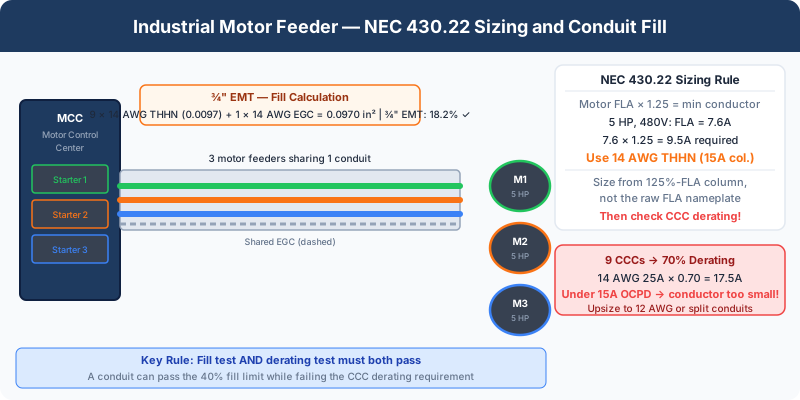
Three 5 HP, 480V, 3-phase motors (FLA = 7.6A each from NEC Table 430.250)
Required conductor: 7.6 × 1.25 = 9.5A → 14 AWG THHN (15A column, 75°C)
Each motor: 3 phase conductors + 1 EGC = 4 conductors × 3 motors = 12 conductors total (1 shared EGC may serve all three if sized appropriately)
With 12 × 14 AWG THHN (0.0097 in²) + 1 × 14 AWG EGC:
Total: 12 × 0.0097 + 0.0097 = 0.1164 + 0.0097 = 0.1261 in²
Required conduit: 0.1261 ÷ 0.40 = 0.3153 in² minimum → ½-inch EMT (0.304 in²) is just shy; use ¾-inch EMT (0.533 in²)
But with 12 current-carrying conductors, NEC 310.15(B)(3)(a) derating applies at the 50% factor (10-20 CCCs). 14 AWG THHN at 90°C: 25A × 0.50 = 12.5A. With each motor circuit protected at 15A (maximum per NEC 430.52 for inverse time breaker on 5 HP motor), the derated 12.5A is below the 15A protection. This means the three motor feeders should not share a single conduit without increasing conductor size to 12 AWG.
This is a case where the fill test passes but the derating test fails. Both must be checked.
Hazardous Location Conduit: Rigid Metal Conduit Requirements
In hazardous locations (NEC Articles 500-516), RMC or rigid nonmetallic conduit (RNC) is often required rather than EMT. The explosion-proof requirement for Class I, Division 1 locations mandates metallic conduit with threaded fittings - typically RMC with explosion-proof conduit bodies.
RMC has a smaller interior than EMT at the same trade size:
For hazardous location calculations, select RMC in the conduit fill calculator to apply the correct Table 4 interior area values.
NEC Article 501 (Class I hazardous locations) requires that conduit systems in Division 1 areas be sealed within 18 inches of every explosion-proof enclosure. Sealing fittings (such as Crouse-Hinds EYS or equivalent) contain only a poured sealing compound and no conductors - they effectively act as a pull point but add length. Account for sealing fitting locations in your conduit layout planning.
Continuous Load Sizing
Industrial circuits often supply continuous loads - equipment that operates at full load for 3 hours or more (NEC definition of "continuous load"). NEC 210.20(A) and 430.22 both have continuous load provisions.
For non-motor continuous loads, the overcurrent protective device and circuit conductors must be sized at 125% of the continuous load current. A 40A continuous load requires:
Continuous load sizing increases conductor gauge, which increases fill area per conductor. When planning conduit for continuous-load industrial circuits, start with the 125%-sized conductors in your fill calculation, not the nameplate load current.
Industrial Panel Feed Example
A 3-phase, 480V industrial sub-panel serving a machine room needs:
Total: 4 × 0.2223 + 0.0824 = 0.8892 + 0.0824 = 0.9716 in²
Required interior area: 0.9716 ÷ 0.40 = 2.429 in²
From NEC Table 4 (RMC, since this is an industrial environment with physical damage risk):
Use 2-inch RMC for this panel feed. Verify in the conduit fill calculator: select RMC, 2-inch, THHN, 3/0 AWG, 4 conductors for the main conductors, then check the EGC separately.
Key Industrial Conduit Fill Considerations
For fill calculations on industrial motor and feeder circuits, use the NEC conduit fill calculator. For the derating interaction, see wire derating and ampacity in conduit. For the foundational fill rules, see NEC conduit fill rules explained.
Conduit Fill Calculator Team
Electrical professionals building free, NEC-accurate conduit fill tools for working electricians, contractors, and inspectors.