PVC vs EMT Conduit: Cost, Installation, and Code Guide
PVC and EMT each have clear advantages depending on the application. This guide covers fill areas, cost, installation requirements, and NEC permitted uses.
Bottom Line
Use EMT for indoor metallic raceway installations where physical protection and grounding continuity are priorities. Use PVC for direct burial, concrete encasement, wet locations, or where corrosion resistance matters more than mechanical strength. PVC Schedule 40 offers more interior area than PVC Schedule 80 of the same trade size - which directly affects how many conductors you can run.
PVC and EMT are the two most common conduit types in residential and light commercial work. Each has real advantages and real limitations. Here's a direct comparison across the factors that matter most on the job.
Interior Area and Conduit Fill
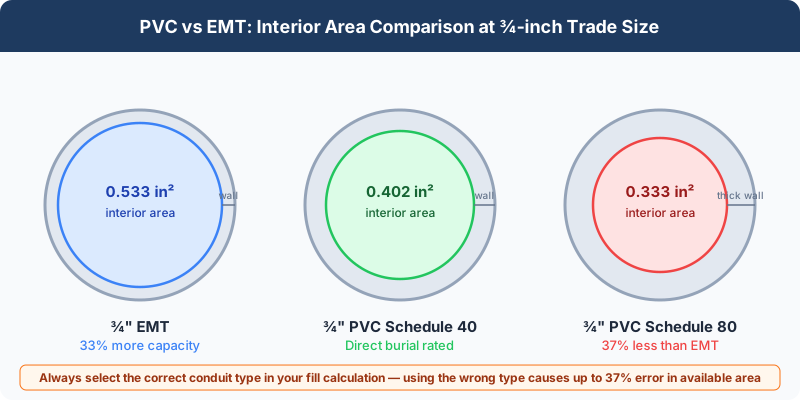
Because PVC Schedule 80 has thicker walls than Schedule 40, it has less interior space - which means fewer wires per conduit at the same trade size.
Interior areas from NEC Chapter 9, Table 4:
| Trade Size | EMT (in²) | PVC Sch 40 (in²) | PVC Sch 80 (in²) |
|---|---|---|---|
| ½-inch | 0.304 | 0.217 | 0.217 |
| ¾-inch | 0.533 | 0.402 | 0.333 |
| 1-inch | 0.864 | 0.660 | 0.586 |
| 1¼-inch | 1.496 | 1.150 | 1.034 |
EMT consistently offers more interior area than PVC of the same trade size. For a ¾-inch conduit, EMT has 0.533 in² available versus 0.402 in² for PVC Schedule 40 - 33% more capacity. If your calculations show a PVC conduit near the fill limit, check whether the same trade size in EMT would solve the problem before going up a size.
Use our conduit fill calculator to compare fill percentages for different conduit types instantly.
Where Each Type Is Permitted by NEC
EMT - NEC Article 358
EMT is permitted in:
EMT is NOT permitted in:
PVC Schedule 40 and 80 - NEC Article 352
PVC is permitted in:
PVC is NOT permitted in:
Note: Some jurisdictions prohibit PVC in certain indoor applications even where NEC permits it. Always verify local amendments with your AHJ.
Cost Comparison
At current (2026) pricing for standard materials:
| Trade Size | EMT (per ft) | PVC Sch 40 (per ft) | PVC Sch 80 (per ft) |
|---|---|---|---|
| ½-inch | $0.45-0.65 | $0.30-0.50 | $0.55-0.75 |
| ¾-inch | $0.65-0.90 | $0.45-0.65 | $0.75-0.95 |
| 1-inch | $0.90-1.20 | $0.65-0.85 | $0.95-1.20 |
PVC Schedule 40 is typically the cheapest conduit option, especially for longer buried runs. EMT is moderately priced and often comparable to Schedule 80 at larger trade sizes. For a 500-foot direct burial run, PVC Schedule 40 can save $100-$200 in materials versus equivalent EMT with a concrete encasement - and eliminates the need for the encasement entirely.
Installation Differences
Bending: EMT bends with a hand or mechanical bender. PVC requires a heat gun or PVC pipe heater to soften before bending. Heated PVC bends are quicker for simple offsets but can't match the precision of a mechanical bender for complex layouts. Cold PVC cannot be bent - attempting it cracks the conduit.
Joining: EMT uses set-screw or compression fittings - no adhesive needed. PVC uses solvent-weld cement. Properly cemented PVC joints are actually stronger than the conduit itself. EMT fittings can be loosened over time by vibration or improper installation; PVC joints are permanent.
Weight: PVC is significantly lighter than EMT, especially for larger trade sizes. A 10-foot stick of 1-inch EMT weighs about 5.2 lbs. The same length of 1-inch Schedule 40 PVC weighs about 1.9 lbs. For above-ceiling runs requiring many supports, weight affects installation time and support spacing.
Grounding: EMT can serve as an equipment grounding conductor when properly connected (NEC 358.60). PVC cannot serve as an EGC - you must include a separate grounding conductor in every PVC conduit run. This adds a conductor to every PVC run, increasing fill calculations and material cost.
The Grounding Conductor Difference and Fill Implications
When you run wiring in PVC conduit, you need a separate EGC in the conduit. This additional conductor takes up fill space that doesn't exist in an EMT run where the conduit itself is the EGC.
Example: a 20A/120V circuit with 12 AWG THHN in ½-inch conduit.
Both pass. But in PVC, you have 18.4% fill instead of 8.8%, and you've used a ½-inch PVC instead of ½-inch EMT - which has 29% less interior area. As circuits get more complex, the difference becomes more significant.
Which to Choose
Choose EMT when:
Choose PVC when:
For fill calculations that account for the additional EGC in PVC runs, use our conduit fill calculator - select PVC Schedule 40 or 80 as the conduit type and include the EGC in your conductor count.
For more on how conduit type affects fill area, see EMT vs IMC vs RMC compared. For conduit sizing from scratch, see how to size conduit for any wiring job.
Conduit Fill Calculator Team
Electrical professionals building free, NEC-accurate conduit fill tools for working electricians, contractors, and inspectors.