When to Use Conduit in Residential Wiring: A Code Guide
Conduit isn't required everywhere in homes, but NEC mandates it in specific locations. Learn where conduit is required, where it's optional, and how to size it correctly.
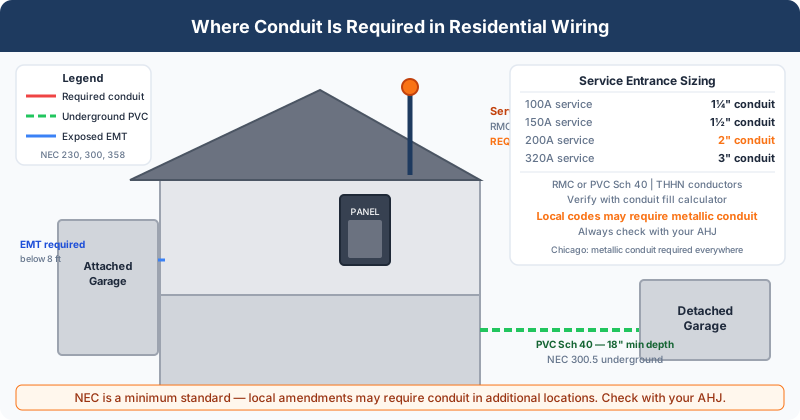
Short Answer
Conduit is required in residential wiring where conductors are exposed to physical damage or specific environmental conditions: service entrance conductors, garage and exterior wiring in exposed locations, basement and crawl space runs that aren't protected by framing, and wherever local amendments require it. Conduit is optional - but often preferred - for kitchen circuits, outdoor GFCI circuits, and panel feeder runs.
Residential electrical work leans heavily on cable assemblies like NM-B (Romex) and AC cable. But there are specific situations where the NEC requires conduit, and others where using conduit is simply the smarter choice. Here's where conduit is required in homes, where it's optional, and how to calculate fill for residential conduit runs.
Where the NEC Requires Conduit in Homes
Service Entrance Conductors
The service entrance conductors connecting the utility weatherhead to the meter base are exposed to weather, UV, and potential physical damage. NEC 230.6 through 230.9 addresses service conductors; most residential service entrance conductors are installed in Schedule 40 PVC or RMC where they run down the exterior of the house from the weatherhead.
Typical residential 200A service entrance: four 2/0 AWG THHN or XHHW-2 conductors (2 hots + 1 neutral + 1 EGC) in 2-inch Schedule 40 PVC or RMC. Run this through our conduit fill calculator: select PVC Schedule 40, 2-inch, XHHW-2, 2/0 AWG, 4 conductors. Result: approximately 23% fill - comfortably within the 40% limit.
Garage Wiring - Exposed Locations
NEC 230.70 and the general requirements for exposed wiring in garages (Article 550 for manufactured homes, general articles for site-built homes) require that conductors exposed to physical damage be protected. An NM-B cable run along an unfinished garage wall where it's exposed is typically required to be in conduit - or protected by a physical raceway - below 8 feet from the floor.
EMT is the most common choice in attached and detached garages: easy to bend, provides good physical protection, and serves as the EGC.
Underground Runs Between Structures
Running power from the house to a detached garage, shed, or outbuilding underground requires conduit or direct-burial cable. NEC 300.5 sets minimum burial depths:
For cost and ease of installation, most contractors run Schedule 40 PVC at 18-inch depth for residential underground feeds. Calculate fill for the underground section separately from any above-grade EMT run.
Exterior Exposed Wiring
Any conductors exposed on the exterior of a building that aren't weatherproof-listed cable assemblies need conduit. PVC Schedule 40 or 80 (weather-resistant) and RMC are common choices for exterior risers and runs along building surfaces.
Where Conduit Is Optional But Recommended
Panel Feeders and Sub-Panel Runs
A feeder run from the main panel to a sub-panel can use conduit or appropriately-sized cable. Conduit has advantages: easier to upgrade conductors later, protects against physical damage, and allows higher conductor fill if the sub-panel is far away.
For a 100A sub-panel feed: three 1 AWG THHN conductors (2 hots + 1 neutral) plus one 6 AWG EGC in 1¼-inch EMT. Verify fill: three 1 AWG THHN (0.1562 in² each) plus one 6 AWG THHN (0.0507 in²). Total: 0.4686 + 0.0507 = 0.5193 in². In 1¼-inch EMT (1.496 in²): 0.5193 ÷ 1.496 = 34.7% - PASS. Use the fill calculator to verify any feeder combination.
Kitchen and Bath Circuits in Finished Walls
NM-B cable is the standard for kitchen and bath circuits in most residential construction. But in remodel work where you're fishing through finished walls and can't run NM-B easily, conduit through a wall chase is sometimes the practical solution. EMT in finished wall cavities is code-legal and gives future flexibility.
Outdoor GFCI Circuits
While direct-burial cable and weatherproof-rated cable are code-legal for most outdoor outlets, running 12 AWG THHN in Schedule 40 PVC gives you better long-term reliability in ground contact and easier future changes. All exterior outlets require GFCI protection (NEC 210.8(A)(3)).
Conduit Fill in Residential Applications
Residential conduit runs typically involve relatively few conductors, so fill is rarely the primary constraint. The more common issue is conductor sizing for the load plus minimum conduit size for practical wire pulling.
Common residential fill calculations:
15A branch circuit in ½-inch EMT:
3 × 14 AWG THHN (0.0097 in² each): 3 × 0.0097 = 0.0291 in²
½-inch EMT interior area: 0.304 in²
Fill: 0.0291 ÷ 0.304 = 9.6% - PASS
20A branch circuit in ½-inch EMT:
4 × 12 AWG THHN (0.0133 in² each): 4 × 0.0133 = 0.0532 in²
Fill: 0.0532 ÷ 0.304 = 17.5% - PASS
200A residential service in 2-inch PVC Sch 40:
4 × 2/0 AWG THHN (0.2223 in² each): 4 × 0.2223 = 0.8892 in²
2-inch PVC Schedule 40 interior area: 2.982 in²
Fill: 0.8892 ÷ 2.982 = 29.8% - PASS
All of these are well under the 40% limit - which is typical for residential work where conduit is sized for the circuit rather than optimized for maximum fill.
Local Amendments
Some states and municipalities impose requirements beyond the NEC minimum. Chicago, for example, requires metallic conduit for virtually all residential wiring - NM-B cable is not permitted for most applications within the city limits. Cities like New York, Los Angeles, and San Francisco have their own local electrical codes that supplement or modify NEC requirements.
Always check with your local AHJ before assuming NEC-minimum compliance is sufficient. Your permit inspector will tell you if local amendments apply.
Sizing Conduit for Residential Service Entrances
The most significant residential conduit sizing decision is typically the service entrance. Here's a quick reference:
| Service Size | Conductor Size | Conduit (RMC/PVC Sch 40) |
|---|---|---|
| 100A | 1 AWG THHN | 1¼-inch |
| 150A | 1/0 AWG THHN | 1½-inch |
| 200A | 2/0 AWG THHN | 2-inch |
| 320A | 350 kcmil THHN | 3-inch |
These are starting points; always verify with a fill calculation using the correct conduit type and all conductors. For immediate verification, use our NEC conduit fill calculator.
For the NEC rules governing fill percentages, see NEC conduit fill rules explained. For guidance on PVC vs EMT selection, see our PVC vs EMT comparison.
Conduit Fill Calculator Team
Electrical professionals building free, NEC-accurate conduit fill tools for working electricians, contractors, and inspectors.