THHN vs THWN-2: Differences, Uses, and When It Matters
Most THHN wire sold today is dual-rated THHN/THWN-2. Learn when the distinction matters, what the ratings mean, and how wire type affects conduit fill.
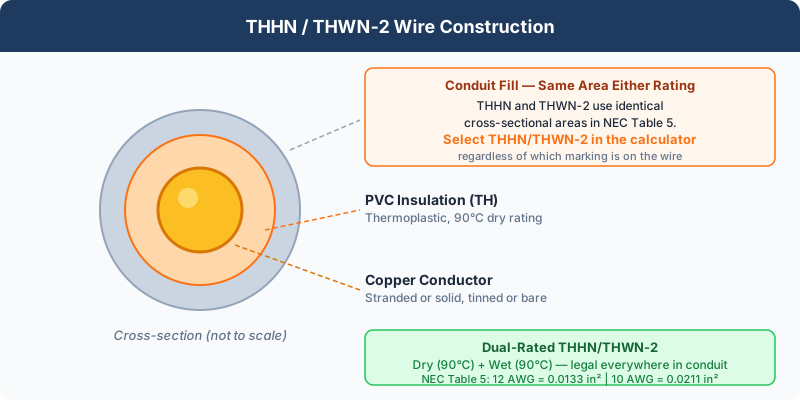
Quick Answer
THHN is rated for dry locations only (90°C). THWN-2 adds a wet-location rating at 90°C. Most wire sold today carries both ratings and is marked THHN/THWN-2 - meaning it's legal in both dry and wet conduit installations. For conduit fill purposes, both use the same cross-sectional area values in NEC Chapter 9, Table 5.
Walk into any electrical supply house and the wire on the spool says "THHN/THWN-2." This dual marking causes confusion - which rating applies? Do you calculate fill differently depending on which part of the label you read?
The distinction matters in some installations and is purely academic in others. Below is what the letter codes actually mean and when picking one over the other affects the install.
Decoding the Letter Codes
Wire insulation ratings are encoded in the designation letters:
So THHN means: thermoplastic insulation, 90°C dry rating, nylon jacket.
THWN-2 means: thermoplastic insulation, wet location rated, 90°C, nylon jacket.
The nylon jacket on both types is what makes them suitable for conduit - it reduces friction during wire pulls and protects the PVC insulation layer underneath.
Why Most Wire Is Dual-Rated Today
Manufacturers discovered that adding THWN-2 capability to THHN wire costs almost nothing - the same materials satisfy both standards. Labeling wire THHN/THWN-2 makes it sell in more markets without adding to production cost. So if you buy THHN today, you almost certainly have THWN-2 capability included.
This matters when you run conduit outdoors, through wet basements, or in locations where condensation may enter the conduit. A purely THHN-rated wire in those locations would technically be a code violation. With dual-rated THHN/THWN-2, you're legal everywhere.
Temperature Ratings and Ampacity
The insulation temperature rating affects allowable ampacity under NEC 310.15 and the correction factors in 310.15(B).
| Rating | Dry Location | Wet Location | Typical Ampacity (12 AWG) |
|---|---|---|---|
| THHN | 90°C | Not listed | 30A (before derating) |
| THWN | 75°C | 75°C | 25A (before derating) |
| THWN-2 | 90°C | 90°C | 30A (before derating) |
In practice, NEC 110.14(C) limits you to the 75°C ampacity column for most circuit terminations, even if the wire is rated 90°C. The 90°C column is mainly used for high-temperature applications and derating calculations where the starting point matters. See our wire derating guide for how this plays out in conduit runs.
Conduit Fill: THHN vs THWN-2 Uses the Same Table
For conduit fill calculations, THHN and THWN-2 use the same conductor cross-sectional areas in NEC Chapter 9, Table 5 - because the physical wire dimensions are identical. A 12 AWG THHN and a 12 AWG THWN-2 both have an area of 0.0133 in².
When using our NEC conduit fill calculator, select "THHN/THWN-2" for both designations. The calculation result is the same either way.
XHHW-2: The Bigger Difference
If your wire is XHHW-2 rather than THHN, the cross-sectional area is different - and it matters more for conduit fill.
XHHW-2 uses cross-linked polyethylene (XLPE) insulation instead of thermoplastic PVC. XLPE has different mechanical properties and the insulation profile is slightly thicker.
A 12 AWG THHN/THWN-2 has a conductor area of 0.0133 in².
A 12 AWG XHHW-2 has a conductor area of 0.0172 in².
That's 29% more area per conductor. In a tight conduit run, using XHHW-2 where you assumed THHN areas can flip a PASS to a FAIL. Always verify insulation type before running fill calculations.
Use the calculator at conduitfillcalculator.com - it handles THHN/THWN-2, XHHW-2, and USE-2/RHH/RHW-2 separately with the correct Table 5 values.
When to Choose THHN/THWN-2 vs XHHW-2
Choose THHN/THWN-2 for:
Choose XHHW-2 for:
THHN in Wet Locations: The Code Requirement
If your conduit passes through a wet location - outdoors, in a crawl space with water exposure, or through a slab where condensation can form - you need wire rated for wet locations. Purely THHN-rated wire (without the THWN-2 marking) isn't listed for wet locations.
In practice, since virtually all commercial THHN wire sold today is dual-marked THHN/THWN-2, this is rarely a problem. But verify the wire marking before using it in wet locations. If you're pulling old wire from a spool that just says "THHN" with no wet location rating, don't use it in wet areas without checking the manufacturer's data sheet.
Quick Reference: Common Wire Types for Conduit
For calculating how many of any wire type fit in your conduit, the conduit fill calculator applies the correct cross-sectional area automatically. Select the correct insulation type from the dropdown and the NEC Table 5 values are handled for you.
For an overview of how wire derating interacts with fill calculations, see wire derating and ampacity in conduit. For the full fill limit rules, see NEC conduit fill rules explained.
Conduit Fill Calculator Team
Electrical professionals building free, NEC-accurate conduit fill tools for working electricians, contractors, and inspectors.