7 Conduit Fill Mistakes That Fail Inspections
These 7 conduit fill errors cause the most inspection failures. Each one is easy to avoid once you know what to look for.
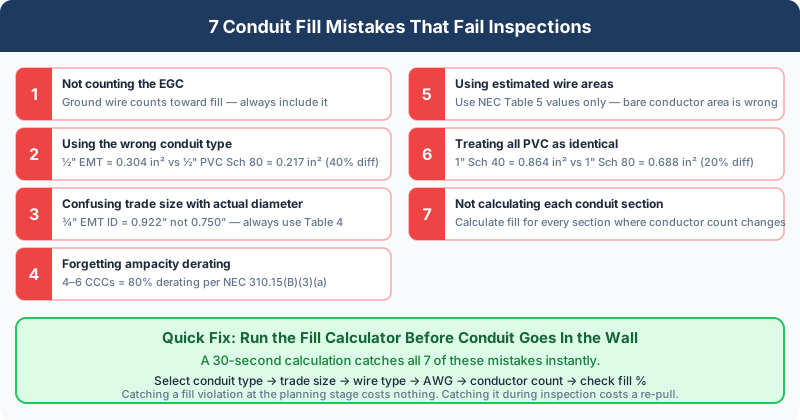
The Top Offenders
The most common conduit fill mistakes: (1) not counting the ground wire, (2) using wrong conduit type in calculations, (3) confusing trade size with actual diameter, (4) forgetting to derate ampacity when fill is high, (5) using estimated wire areas instead of NEC Table 5 values, (6) treating all PVC conduit as the same, and (7) not accounting for splice boxes that may concentrate fill.
Conduit fill violations are among the top 10 NEC inspection failures in residential and commercial work. Most are preventable. Here are the seven mistakes that keep showing up on failed inspection reports - and exactly how to avoid each one.
Mistake 1: Not Counting the Equipment Grounding Conductor
This is the #1 conduit fill error. An electrician calculating fill for a 20A branch circuit might think: "Two hots and a neutral - that's three 12 AWG conductors." But the EGC is also in that conduit. Four conductors, not three.
The impact: With three 12 AWG THHN in ½-inch EMT, fill is 13.1% - well under the 40% limit. Add the fourth wire and it's 17.5% - still fine. But on a heavily loaded conduit, that missing EGC can be the wire that pushes fill over the limit.
The fix: Before calculating, list every wire going into the conduit. Run through the circuit type:
Then use our conduit fill calculator with the correct total conductor count.
Mistake 2: Using the Wrong Conduit Type
EMT, IMC, RMC, and PVC Schedule 40/80 have different interior areas even at the same trade size. A ½-inch EMT has 0.304 in² of interior area. A ½-inch PVC Schedule 80 has only 0.217 in². Using EMT dimensions when you've installed Schedule 80 PVC inflates your available area by 40% - meaning what looks like a PASS on paper is actually a FAIL in the wall.
The fix: Know what type of conduit is installed before calculating. If the conduit is already in and you can't tell EMT from RMC by eye, check the markings - EMT has a characteristic thin wall and is typically painted or galvanized, while RMC threads at the ends.
Always select the correct conduit type in the fill calculator. The dropdown options correspond to the specific Table 4 values in NEC Chapter 9.
Mistake 3: Confusing Trade Size with Actual Diameter
¾-inch trade size EMT has a 0.922-inch interior diameter - not 0.75 inches. Using the trade size number as the actual diameter and calculating π × r² will give you a completely wrong answer.
The impact: π × (0.375)² = 0.442 in² (wrong) versus the actual 0.533 in². A 20% error in your available conduit area changes whether borderline calculations pass or fail.
The fix: Never calculate conduit area from trade size. Always look up the interior area from NEC Chapter 9, Table 4, or let the fill calculator do it automatically by selecting the conduit type and trade size from the dropdowns.
Mistake 4: Calculating Fill But Forgetting Ampacity Derating
Conduit fill has two separate code requirements that must both be satisfied. NEC Chapter 9 limits fill percentage. NEC 310.15(B)(3)(a) requires ampacity derating when you have more than three current-carrying conductors in the same conduit.
A run of six 12 AWG THHN in ¾-inch EMT might pass fill (6 × 0.0133 ÷ 0.533 = 15% - PASS). But six current-carrying conductors triggers a 0.80 derating factor. A 12 AWG THHN wire has a 30A ampacity at 90°C, derated to 24A - which is fine for a 20A circuit. But with 7-9 conductors, the derating drops to 0.70, meaning 12 AWG can only carry 21A before being limited to 20A by the breaker anyway. Push to 10+ conductors and you need to recheck whether 12 AWG is still appropriate.
The fix: Fill and ampacity derating are separate calculations. Running the conduit fill calculator verifies fill. Ampacity derating must be checked separately using NEC 310.15 and the conductor ampacity tables.
Mistake 5: Using Estimated Wire Areas Instead of Table 5 Values
Some electricians use wire area approximations from memory or from manufacturer cut sheets that don't match NEC Table 5. The NEC table values are the required reference - using other sources can produce errors.
Example: A 12 AWG THHN wire's actual conductor (copper) cross-section is 0.00519 in². The NEC Table 5 area for 12 AWG THHN is 0.0133 in² - that's the conductor plus insulation plus nylon jacket. Fill calculations use the total wire outside diameter, not the bare conductor area.
The fix: For any conduit fill calculation that will be inspected, use NEC Chapter 9, Table 5 values. The fill calculator uses these values directly - that's the safest approach.
Mistake 6: Treating All PVC Conduit as Identical
PVC Schedule 40 and PVC Schedule 80 carry the same trade size labeling but have different interior diameters. A 1-inch Schedule 40 has 0.864 in² interior area; a 1-inch Schedule 80 has 0.688 in² - 20% less available space.
This matters most on runs where you're near the fill limit. If your calculations assume Schedule 40 dimensions but the installed conduit is Schedule 80, a pass becomes a fail.
Schedule 80 is physically thicker-walled and identifiable by its gray color (Schedule 40 is typically white or light gray for indoor use - though color varies by manufacturer). Always verify conduit specifications before calculating.
Mistake 7: Concentrating Too Many Wires at Pull Boxes
Conduit fill calculations apply to the conduit, not the pull box - but inspectors also look at whether conductors are adequately sized relative to the pull box volume under NEC Article 314. More commonly, electricians miscalculate fill on a run because they're calculating for the conduit in the middle of the run but not accounting for a section where multiple circuits merge at a pull box before separating again.
The fix: Calculate fill for every section of conduit independently if the conductor count changes between sections. If six circuits enter a pull box from one side and all exit together through a single conduit on the other, that exit conduit needs its own fill calculation for all six circuits combined.
The fastest way to avoid all of these mistakes: run every conduit fill calculation through the conduit fill calculator before the conduit goes in the wall. The five inputs take 30 seconds; a re-pull takes hours.
For the underlying NEC rules, see NEC conduit fill rules explained. For guidance on selecting conduit size in the first place, see how to size conduit for any wiring job. For details on conduit types and their fill areas, see EMT vs IMC vs RMC.
Conduit Fill Calculator Team
Electrical professionals building free, NEC-accurate conduit fill tools for working electricians, contractors, and inspectors.