NEC 2023 Conduit and Wiring Updates: What Changed?
The NEC 2023 edition includes targeted updates to conduit fill, conductor sizing, and wiring methods. Here's what changed and how it affects your calculations.
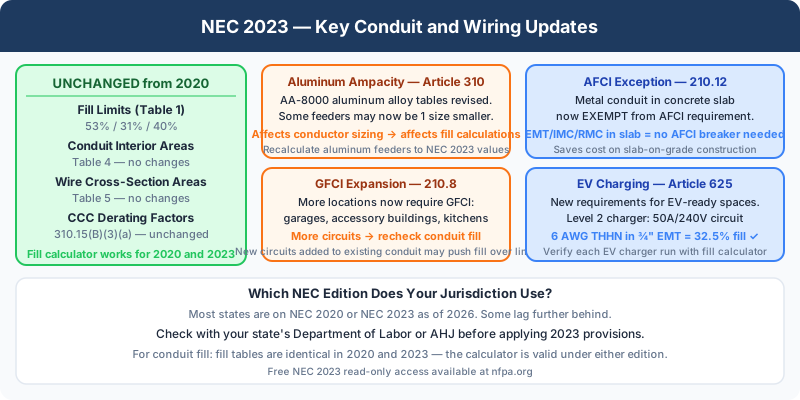
What Changed (And What Didn't)
The NEC 2023 edition didn't overhaul conduit fill fundamentals - the Chapter 9 fill tables and Table 1 limits (53%/31%/40%) remain unchanged. Key 2023 updates affecting conduit work include revised ampacity tables for aluminum conductors, expanded requirements for GFCI and AFCI protection, updated minimum conduit sizes for certain applications, and clarifications around EV charging wiring in conduit. Always verify which edition your jurisdiction has adopted.
The National Electrical Code updates on a three-year cycle. The 2023 edition (NFPA 70, 2023) includes hundreds of revisions - but for the electrician focused on conduit fill and conductor sizing, the core rules haven't fundamentally changed. The 2023 changes that actually affect conduit and conductor sizing decisions in the field are below.
What Did NOT Change in NEC 2023
Let's start here, because this matters most for day-to-day conduit work:
The conduit fill calculator at conduitfillcalculator.com uses NEC 2023 Chapter 9 values, which are the same as 2020 values for standard conduit and conductor types.
Aluminum Conductor Ampacity Revisions (Article 310)
NEC 2023 revised the aluminum conductor ampacity tables in 310.15 to more accurately reflect modern aluminum alloy wire. Aluminum conductors, particularly AA-8000 series alloy, can now carry more current per gauge than the previous NEC edition's tables showed.
Why this matters for conduit work: If you're sizing an aluminum feeder in conduit - common for 200A residential services and commercial feeders - the new ampacity values may let you use one size smaller than the 2020 NEC would have required. This affects conduit sizing if the smaller conductor means less fill.
Example: A 200A aluminum feeder that previously required 4/0 AWG AA-8000 may now be achievable with 3/0 AWG under revised 2023 values (depending on temperature correction and derating). Always calculate for your specific conditions - see our guide on wire derating and ampacity.
Expanded GFCI Protection Requirements (210.8)
NEC 2023 expanded GFCI requirements to additional locations, including:
Conduit implication: Expanding GFCI circuits means more circuits need to run to new locations. This can affect conduit sizing calculations where you're adding circuits to existing runs. If you're upgrading a garage panel feed to accommodate new GFCI circuits, re-run your fill calculations with the additional conductors.
AFCI Expansion (210.12)
Arc-Fault Circuit Interrupter (AFCI) protection requirements expanded in 2023 to cover additional areas in dwelling units, including more areas of commercial occupancies. AFCI-protected circuits typically use combination-type AFCI breakers, which don't change conduit wiring - the conductors in the conduit are the same.
The NEC 2023 added an exception: AFCI protection is not required for branch circuits wired with metallic conduit (EMT, IMC, or RMC) installed in a concrete slab. This exception recognizes that metal conduit provides an inherent level of arc fault containment. If you're running conduit in slab construction, this exception may let you avoid AFCI breakers in certain applications.
EV Charging Infrastructure (625.17 and New Articles)
NEC 2023 added significant new content around electric vehicle (EV) charging, including requirements for EV-ready spaces in new residential construction and EV charging station wiring.
EV charging circuits are high-ampacity loads - a Level 2 charger typically runs on a 240V/50A circuit. In conduit, this means:
50A EV circuit in EMT (6 AWG THHN, 3 conductors + EGC):
3 × 6 AWG THHN (0.0507 in²) + 1 × 10 AWG EGC (0.0211 in²) = 0.1521 + 0.0211 = 0.1732 in²
In ¾-inch EMT (0.533 in²): 0.1732 ÷ 0.533 = 32.5% fill - PASS
Verify any EV charger conduit run with the conduit fill calculator before roughing in.
Wiring Method Clarifications
NEC 2023 clarified several wiring method permissions and restrictions:
ENT (Electrical Nonmetallic Tubing, Article 362): Clarified that ENT is not permitted in walls of buildings with more than three floors above grade. This impacts choices between ENT and PVC or EMT on mid-rise construction.
FMC and LFMC (Articles 348 and 350): Minor clarifications on permitted uses and support requirements. Support spacing remains 4.5 feet maximum for FMC, with shorter maximums at terminations.
Concealed Knob-and-Tube Wiring (Article 394): Additional restrictions on mixing with modern wiring methods - relevant for renovation work in older homes that may involve routing new conduit alongside existing wiring.
Which NEC Edition Does Your Jurisdiction Use?
The NEC 2023 edition was published in August 2022. Jurisdictional adoption varies widely:
Check with your state's Department of Labor or the AHJ directly to confirm the adopted code edition before applying NEC 2023 provisions. Performing work to a newer code edition than your jurisdiction has adopted doesn't automatically make it legal - local inspectors enforce the adopted edition.
For conduit fill calculations, this distinction doesn't matter because Table 1, Table 4, and Table 5 values are unchanged from 2020 to 2023. Our fill calculator produces correct results under either edition.
Key References for NEC 2023 Conduit Work
For the complete NEC 2023 text, NFPA offers free read-only access at nfpa.org. Physical copies are available from NFPA, NECA, and major electrical distributors.
For the practical application of NEC conduit fill rules unchanged from 2023, see NEC conduit fill rules explained. For conduit sizing from scratch, see how to size conduit for any wiring job.
Conduit Fill Calculator Team
Electrical professionals building free, NEC-accurate conduit fill tools for working electricians, contractors, and inspectors.